[PDF version can be downloaded here.]
The conduct of a true Vaiṣṇava is defined not by personal whim or modern social trends, but by a strict adherence to the mandates of Śruti and Smṛti. In the Vedic tradition, the way we address and perceive others is a direct reflection of our internal consciousness and our submission to the Lord’s authority. Central to this social and spiritual fabric is the vision of motherhood—the foundational principle that every woman, with the exception of one’s own wife, must be seen and treated with the same reverence as one’s own mother. While Śrīla Prabhupāda, occasionally made linguistic adjustments to accommodate the cultural limitations of the Western world, a deeper analysis of his instructions reveals a steadfast commitment to this Vedic standard. By examining scriptural precedents from the Manu-smṛti, Nāṭya Śāstra, and the Purāṇas, this article explores the essential nature of addressing women in Vedic civilization and clarifies the distinction between the compassionate adjustments of a Mahā-bhāgavata and the formal instructions intended for his followers.
Those who have accepted Lord Viṣṇu as their Supreme Deity—in other words, the devotees of Viṣṇu —are known as Vaisṇavas. The feminine form of the word is Vaiṣṇavī, which is derived by applying the grammatical suffix ṅīp. Such Vaisṇavas and Vaiṣṇavīs are obligated to follow the regulations prescribed in the Śruti and Smṛti. The instructions contained within these scriptures are considered the direct orders of the Lord. A devotee who claims to be a follower yet disregards these mandates is not a devotee in reality, as he is denying the Lord’s authority.[1] Therefore, for every detail of conduct, one must strictly adhere to the Vedic scriptures.
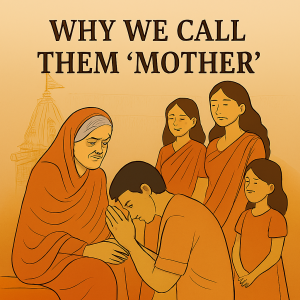
According to Vedic texts, all women—with the exception of one’s own wife—are to be regarded as equal to one’s own mother.[2] The one who feeds a child out of her breast, the one who gives birth out of the womb, wife of the teacher, wife of the family god, wife of the father, pregnant daughter, sister, wife of the son, mother of the wife, mother of the mother, mother of the father, wife of the brother, sisters of mother and father, maternal aunt, the wife of the king, wife of the Brāhmaṇa, the wife of the friends and their mothers, the wives of the parents, one’s own daughter, the mother, co-wife, the cow, mid-wife, the one who provides food, the one who removes the danger, are all considered to be like mothers.[3] Therefore an intelligent person must look upon another’s wife as being like his mother. The best example of this is Lord Rāmacandra, the embodiment of dharma. The exceedingly strong, valiant, and pious Lord Rāma—who is devoted to Daśaratha and free from all self-importance—conducts himself toward all the King’s queens just as he does toward his own mother, Kauśalyā. He treats every woman upon whom Daśaratha has bestowed even a single glance with the same reverence he holds for his mother.[4]
The essential emotion behind addressing women in Vedic civilization is rooted in the sanctity of motherhood. According to scriptures like the Manu-smṛti (2.129) and Viṣṇu Smṛti (32.7), women who are not related by birth or are unknown are traditionally addressed using terms such as Bhavati (Lady), Bhaginī (Sister), Mātā (Mother), Subhage (Blessed) and Putrī (Daughter). Specifically, elders are addressed as Bhavati or Mātā, those of the same age as Bhaginī or Subhage, and those who are younger as Putrī or Bhaginī.[5] Essentially, while elderly women are directly addressed as “Mother,” younger women are called by terms denoting “Sister” or “Daughter” that still carry the same maternal reverence. This is substantiated from the example of Śrimad-Bhāgavataṁ (10.82.20), where King Vasudeva, the father of lord Kṛṣṇa uses the word Amba to refer his sister—Kuntī devī; although Amba primarily means mother, its overlapping usage with “sister” highlights a protective maternal feeling that is often missing in the modern age terms like bahenjī or sister. Similarly, in the Śrimad-Bhāgavataṁ (3.22.25), Emperor Manu addresses his daughter Devahutī with the word Amba, which is used for a daughter, further proving that even the address of “Daughter” contains the essence of “Mother.” Ultimately, all these relationships can be classified into three categories—mother, sister, and daughter[6]—where elderly women are directly called mother or with elderly appropriate terminologies and younger or peer-aged women are addressed with terminologies referring to either mother or sister with the mood of motherhood. Therefore, in the Vedic tradition, even a small girl is seen as a form of the Goddess[7], anchored in the foundational emotion of motherhood that governed every interaction with women.
The Nāṭya Śāstra (Chapter 19.21-29), the best and superior work[8] regarding explaining the rules of dramatically plays, is written by sage Bharata Muni. In this work, he has mentioned different forms of addressing women in the play. Female ascetics and goddesses are to be addressed as “holy lady” (bhagavati). Wives of respectable seniors and of king’s officers (sthānīyā) are to be addressed as “lady” (bhavati). An accessible woman (gamyā) is to be addressed as “gentle-woman” (bhadre) and an old lady as “mother” (amba). In a play, king’s wives are to be addressed by their servants and attendants as “mistress” (bhaṭṭini), “madam” (svāmini), and “lady” (devī). Of these, the term “lady” (devi) should be applied to the chief queen (mahiṣī) by her servants as well as by the king. The remaining wives of the king may be addressed simply as “madam” (svāmini). Unmarried princesses are to be addressed by their handmaids as “young mistress” (bhartṛ-dārikā). An elder sister is to be addressed as “sister” (bhagini) and a younger sister as “child” (vatse). A Brahmin lady, a nun (liṅgasthā), or a female ascetic (vratinī) is to be addressed as “noble lady” (ārye). A wife is to be addressed as “noble lady” (ārye) or by referring to her father’s or son’s name. Women friends among their equals are to be accosted by one another with the word “hallo” (halā). By a superior woman, a handmaid (preṣyā) is to be accosted with the word “hey child” (haṃ-je). A courtesan is to be addressed by her attendants as ajjukā, and when she is an old woman, she is to be addressed by other characters in a play as attā. But priests’ and merchants’ wives are always to be addressed as “noble lady” (ārye). All these are different terminologies used for women by a man, with the consideration of motherhood simultaneously, because all women throughout the world are the portions of the supreme goddess.[9]
Throughout his lectures[10], Śrila Prabhupāda repeatedly emphasized that the essence of Vedic civilization and the perfection of education lie in treating every woman, except for one’s own wife, as a mother. This training begins in childhood, where a brahmacāri is taught to address any woman—whether younger or older—as “Mother” or “Mātāji.” This etiquette is not only a religious principle but a moral necessity, as it establishes a relationship in which an unknown man regards an unknown woman as his mother, and she, in turn, views him as her son. A learned scholar is defined by this vision, understanding that a mother always deserves the highest respect.
Prabhupada specifically noted that while modern society has introduced “Bahinji” (sister), this is not the śastric etiquette. Although the samskṛta term Bhaginī also means sister, it carries an inherent emotion of motherhood; for instance, in the Śrimad-Bhāgavatam (10.4.15), Kamsa himself uses the term bhaginī to address Devakī. While traditional Indian terminologies for “sister” historically shared this maternal connection, the modern usage of bahinji conveys a sense of casual friendliness rather than motherhood. Similarly, the English terminology for “sister,” derived from the Proto-Germanic swestēr, only denotes a female sibling and lacks any maternal connotation.
Śrīla Prabhupāda, in his letters, sometimes called women by their names[11], sometimes with the title ‘Mother[12],’ sometimes ‘Ms.,’ and sometimes he also addressed the audience with the term ‘sisters[13].’ All this was done by Śrīla Prabhupāda as an adjustment. According to time, place, and circumstances, he had done that[14]. But he has not given any such instruction to do otherwise. According to his instructions, women are supposed to be addressed as ‘Mother.’ One should not imitate the Mahā-bhāgavata; rather, one should follow his instructions.[15]
Apart from these, Śrīla Prabhupāda also used the term “Prabhu” for his female disciples.[16] These instances were also according to time and place because, in the Western world where there is a concept of equality, it is very difficult to digest the concept of the Vedic system. Śrīla Prabhupāda also emphasized that women need support and protection from males; therefore, they are subordinate to men, although spiritually they are one.
According to the Varṇāśrama system, women are never independent. The father guards her during virginity, the husband guards her in youth, and the sons guard her in old age; the woman is never fit for independence. This does not lay down that she shall not be independent in regard to anything at all; all that it means is that, her mind being not quite under her control, she is not capable of guarding herself, especially as she does not possess the requisite strength.[17]
Śrīla Prabhupāda never, in his lectures or letters, instructed disciples directly to address female disciples with the term “Prabhu.” Furthermore, for those who are in the stage of Maha-bhagavata—who are beyond the bodily concept of life like Śrīla Prabhupāda —it does not matter whether they call someone “Prabhu” or use other terminologies. However, for those who have not reached such a stage, they need to follow the rules prescribed according to Varṇāśrama, which is systematized according to one’s bodily and mental position.
According to Samskṛta grammar, the word “Prabhu” is for males; it cannot be used for females. The feminine form of “Prabhu” is Prabhvī. But such terms also cannot be used for women because, according to the scriptures, women are not independent. They are dependent on males, and males are independent in the sense that they are not dependent on females. The word “Prabhu” means “master.” Therefore, a protector cannot address those who are protected with the terminology of “master.” Furthermore, the use of Prabhvī for women is neither supported by Vedic texts, and there is not a single direct instruction from Śrīla Prabhupāda to support such a mis-concoction.
Ultimately, the goal of Vedic etiquette is to foster a social environment that protects spiritual progress and upholds the dignity of all living beings. While Śrīla Prabhupāda occasionally utilized terms like “Prabhu” or “Ms.” as a temporary concession to time, place, and circumstance, these instances should be understood as the expert preaching strategies of an empowered soul rather than a permanent change to the Varṇāśrama system. To address a woman as “Mother” is not merely a formality; it is a spiritual safeguard that purifies the mind and establishes a relationship of protection and respect. As followers, we are cautioned not to imitate the actions of the Mahā-bhāgavata, who exists beyond the bodily concept of life, but rather to follow his explicit instructions. By adhering to the scriptural standard and the grammatical roots of our sacred language, we preserve the purity of the Vaiṣṇava tradition and honor the true intent of our Ācārya, ensuring that the sanctity of motherhood remains the cornerstone of our spiritual community.
[1] śruti-smṛtī mamaivājñe yas te ullaṅghya vartate | ājñāc chedī mama dveṣī mad-bhakto’pi na vaiṣṇavaḥ || (Quoted by Jīva Gosvami ( Bhakti Sandarbha Anuccheda 173) , Sanātana Gosvāmī ( Bṛhad Bhāgavatāmṛta 2.2.204 Commentary ) )
[2] Garuḍa Purāṇa (1.111.12)
[3] Brahma-Vaivarta-Purāṇa; Gaṇapati-Khaṇḍa (15.41-43) & Kṛṣṇa-Janma-Khaṇḍa (35.52-56)
[4] Vālmiki Rāmāyaṇa (2.118.5-6)
[5] Manu Bhāṣya by Nandana & Viṣṇu Smṛti commentary by Nanda Paṇḍita
[6] Padma Purāṇa ( Sṛṣṭi Khaṇḍa 19.222)
[7] Devī Bhāgavata (7.39.47)
[8] Suratha Kathāmṛta by Viṣvanātha Cakravarti
[9] Mārkaṇḍeya Purāṇa (88.5)
[10] ( Few quotes – Srimad-Bhagavatam 7.7.29-31 – San Francisco, March 15, 1967;Srimad-Bhagavatam 1.3.13 – Los Angeles, September 18, 1972; Srimad-Bhagavatam 1.3.13 – Los Angeles, September 18, 1972; Srimad-Bhagavatam 3.1.10 – Dallas, May 21, 1973;Bhagavad-gita 1.26-27 – London, July 21, 1973; Srimad-Bhagavatam 1.16.10 – Los Angeles, January 7, 1974; Bhagavad-gita 4.16 – Bombay, April 5, 1974;Srimad-Bhagavatam 1.16.23 – Los Angeles, July 13, 1974; Srimad-Bhagavatam 1.8.24 – Mayapura, October 4, 1974; Srimad-Bhagavatam 6.1.22 – Chicago, July 6, 1975; Srimad-Bhagavatam 6.1.56-57 – Bombay, August 14, 1975; Morning Walk – Nairobi, November 2, 1975; Srimad-Bhagavatam 7.9.9 – Mayapur, February 16, 1976; Srimad-Bhagavatam 6.1.22 – Honolulu, May 22, 1976; Srimad-Bhagavatam 6.1.23 – Honolulu, May 23, 1976; Srimad-Bhagavatam 5.5.3 – Vrndavana, October 25, 1976)
[11] Letter to: Malati 21-04-1968; 06-03-1970; 25-12-1974
[12] Letter to: Yamuna, Malati, Janaki 20-02-1969;
[13] Letter to: Japanese brothers and sisters 10-03-1970 Los Angeles
[14] Morning Walk, March 9, 1974, Mayapur
[15] Śrīmad-Bhāgavatam (10.33.31)
[16] Letter to Ranadhira 16-02-1971; Letter to Ṛṣabhadeva 25-03-1971; Letter to Mukunda 13-04-1971; Letter to Śacimātā 15-10-1976
[17] Manu Smṛti (9.3) & the commentary by Medhatithī
Bibliography
Bhanu Swami, trans. Bhakti Sandarbha: With Commentary of Jīva Gosvāmī (Ṣaṭ-sandarbha, Book 5). Delhi: Tattva Cintāmaṇi Publishing.
Chaturvedi, Ramesh, ed. Brahmavaivarta Purana: Text with English Translation. Translated by Shanti Lal Nagar. 2 vols. 4th ed. Parimal Sanskrit Series 54. Delhi: Parimal Publications, 2021.
Dave, Jayantakrishna Harikrishna, ed. Manu Smṛti with Nine Commentaries by Medhatithi, Sarvajñanārāyaṇa, Kullūka, Rāghavānanda, Nandana, Rāmacandra, Maṇirāma, Govindarāja and Bhāruci. Sanskrit text. Mumbai: Bharatiya Vidya Bhavan, n.d.
Dutt, Manmatha Nath, trans. The Garuda Purana. Calcutta: Society for the Resuscitation of Indian Literature, 1908. Reprint, Delhi: Sri Satguru Publications, 2009.
Gita Press, Gorakhpur. Shrimad Devi Bhagvat Maha Puran. 2 vols. Sachitra, Saral Hindi Vyakhya Sahit. Hindi edition. Gorakhpur: Gita Press, n.d.
Jha, Ganganatha, trans. Manusmriti with the Commentary of Medhatithi. 1920. Reprint, Delhi: Motilal Banarsidass, ISBN 9788120811553.
Jha, Ganganatha, trans. Manusmriti with the Commentary of Medhatithi. Delhi: Motilal Banarsidass, 1920. ISBN 9788120811553.
Jolly, Julius, ed. The Institutes of Vishnu: Together with Extracts from the Sanskrit Commentary of Nanda Paṇḍita Called Vaijayantī. Calcutta: Baptist Mission Press for the Asiatic Society, 1881.
Pargiter, F. Eden, trans. The Markandeya Purana (Markandeya-Puranam): Sanskrit Text, English Translation with Notes and Index of Verses. Edited by K. L. Joshi Shastri. Delhi: Parimal Publications, 2004.
Valmiki Ramayana: Ayodhya Kanda, Sarga 118. ValmikiRamayan.net. Accessed February 1, 2026. [https://www.valmikiramayan.net/utf8/ayodhya/sarga118/ayodhya_118_frame.htm](https://www.valmikiramayan.net/utf8/ayodhya/sarga118/ayodhya_118_frame.htm)
Visvanath Cakravarti Thakura. Sri Surata Kathamrta: The Rasika Talks of Sri Radha and Krsna. Independently Published, July 2023. ISBN B0C9SDND4B.
A. C. Bhaktivedanta Swami Prabhupāda. Srila Prabhupada’s Letters and Lectures. Vedabase. Accessed February 1, 2026. [https://vedabase.io](https://vedabase.io)
A. C. Bhaktivedanta Swami Prabhupāda. Śrīmad Bhāgavatam: Bhagavata Purāṇa. Translated and commentated by A. C. Bhaktivedanta Swami Prabhupāda. Vedabase. Accessed February 1, 2026. [https://vedabase.io](https://vedabase.io)