In his purport to Śrīmad-Bhāgavatam 3.24.40, Prabhupāda says that according to Manu-saṁhitā, women must always be under the protection of a father, husband or grown sons. “So-called spiritual societies concocted in modern times give sannyāsa even to women, although there is no sanction in the Vedic literature for a woman’s accepting sannyāsa.” There is no injunction in the śāstras that explicitly says a woman cannot take sannyāsa, but because the Manu-saṁhitā says women are unfit for independence (na strī svatantryam arhati), women are not permitted to take sannyāsa.
A similar consideration applies to women acting as dīkṣā-gurus. If a guru requires a guardian, then she cannot make even routine decisions concerning her own disciples. In modern law, minors are not permitted to adopt children or enter into contracts precisely because they lack independence; they require a guardian to act on their behalf. Vedic law follows the same principle: a woman is not permitted to undertake such responsibilities because she is considered dependent. Only a father or husband would be authorized to decide who should or should not become a disciple. A woman’s role is traditionally that of guru-mātā—the wife of the guru, or “mother guru”—never the guru herself. Because she lacks independence, she would not be able to accept a disciple without the permission of her father, husband, or even grown sons. One who is deemed unfit for independence, like a child, requires a guardian to make such decisions on her behalf. This is what is meant by Manu-saṁhitā’s injunction that women are unfit for independence.
ISKCON’s GBC, however, has found a way around this injunction. As per its 2019 mid-year general meeting resolution, which “accepts the philosophical conclusion presented in the SAC’s Female Diksa Guru Paper,” the GBC resolved
“Vaisnavis are eligible to give diksa in ISKCON provided that they:
- “Meet all the qualifications listed for ISKCON diksa-guru applicants;
- “Are at least 55 years of age and in a stable family situation, living under the protection of a husband, elder son or son-in-law, qualified householder couple or senior Vaisnava or Vaisnavi sanga;
- “Receive written permission from the appropriate Regional Body or its equivalent, or National Council, to give diksa in that particular part of the world.”
In the above resolution, the GBC creates its own injunctions that contradict Manu. The GBC adds age (Manu gives no concession for age) and adds new protectors—“son-in-law,” “qualifed householder couple,” “Vaisnava sanga” and even a “Vaisnavi sanga.” So, persons not mentioned by Manu can now act as guardians for women, including persons with no family relation to the woman and even other women. But creating new injunctions is not permitted. If it were permitted, then there would be no meaning to Prabhupāda’s statement, “there is no sanction in the Vedic literature.”
If the GBC’s new religious injunctions are allowed to stand, the authority of Manu’s injunction is effectively nullified. Once Manu’s directive is no longer considered binding, Prabhupāda’s argument against female sannyāsa in Bhāgavatam 3.24.40 collapses, since it rests upon that injunction. In such a case, there would be no remaining sanction against women taking sannyāsa, thereby creating the necessary conditions for the emergence of female sannyāsīs within ISKCON.
Although this sounds like a slippery-slope fallacy—a chain of increasingly improbable events that lead to an undesirable or obviously absurd outcome—it should be remembered that slippery-slope arguments do sometimes turn out to be true. In this particular case, there is reason to believe that members of the GBC and their close advisors are giving serious thought to allowing women to take sannyāsa at some point in the future.
In the Śāstric Advisory Council (SAC) paper titled Brahma-gāyatrī Mantra in ISKCON: Varṇāśrama, Bhakti, Principle or Detail? (2021), the devotee named Bṛghupāda Dāsa (Finnish scholar Måns Broo) did some field research on behalf of the SAC. In that research, he interviewed Śrī Gurumātā Jayashree Devī, who is “guru of a Gauḍīya Maṭh temple, Guru Prapanna Ashram, Kolkata,” as well as other disciples in her maṭha. Jayashree Devī herself is a sannyāsī, and her mission gives sannyāsa to women.[1]
As reported in the SAC’s paper,
Śrī Gurumātā Jayasree Devī, to our knowledge the only female guru of a Gauḍīya Math temple, Guru Prapanna Ashram, Kolkata, does not give female disciples the Brahma-gāyatrī. In this regard: ‘Brahma-gāyatrī mantra is not given separately to the women because they are themselves gāyatrī swarūpinī. Gāyatrī is inherently in them. So Gurumātā, following the instructions of her gurudeva, doesn’t give Brahma-gāyatrī. Brahma gāyatrī is passed down to the disciples in male body by Gurumātā’s godbrother or her appointed disciple.’ (136)
While the above statement is a curious point of view, we have to wonder why it is in the SAC’s position paper at all. As Prabhupāda says in his purport to Bhāgavatam 3.24.40, “So-called spiritual societies concocted in modern times give sannyāsa even to women, although there is no sanction in the Vedic literature for a woman’s accepting sannyāsa.” Gurumātā Jayaśrī Devī and her Guru Prapanna Ashram come in the category of “so-called spiritual societies”; their testimony should not have been considered. Yet here it is in a GBC-approved position paper.
Moreover, the devotee-scholar who did the interview is a disciple of Tripurāri Mahārāja, the famous ex-ISKCON book distributor who broke away from ISKCON and founded his own mission. Tripurārī Mahārāja is also in favor of giving women sannyāsa.
He says,
“The heart of Vaisnava sannyasa is renouncing material life and embracing the service of Sri Krishna. This is open to both men and women. Whereas the formality of accepting the renounced order of sannyasa has largely been restricted to men in consideration of socioreligious concerns. However, as circumstances change and these concerns are no longer relevant, I see no reason why women should be barred from accepting sannyasa.”[2]
In a follow-up response to this article, he says,
“As I have stated in the article in question, I personally believe that there is merit in considering the possibility that it may be useful for preaching to award sannyasa to women in our sampradaya.”[3]
Unless there is reason to believe otherwise, it should be assumed that his disciple also shares his guru’s view.
The SAC has accepted testimony from a group that confers sannyāsa upon women—a group that, from Prabhupāda’s perspective, would be regarded as a “so‑called spiritual society.” In doing so, the SAC engaged a scholar who is himself a disciple of a teacher advocating female sannyāsa. The GBC subsequently endorsed the SAC’s paper at their 2023 annual meeting and directed that it be published on the official GBC website. These actions demonstrate institutional openness to perspectives that support female sannyāsa.
At the same time, there is no explicit injunction in śāstra that categorically prohibits women from taking sannyāsa. The only textual basis cited by Śrīla Prabhupāda for such a prohibition is Manu‑saṁhitā (9.3). Once the authority of this verse is set aside—as the GBC has effectively done in its resolution approving female dīkṣā‑gurus—Prabhupāda’s argument against female sannyāsa collapses, since it depends upon that injunction. In the absence of a clear śāstric prohibition, his position is subordinated to new, non‑śāstric directives established by the GBC. Taken together, these doctrinal and institutional developments indicate that ISKCON is moving toward the formal recognition of female sannyāsa.
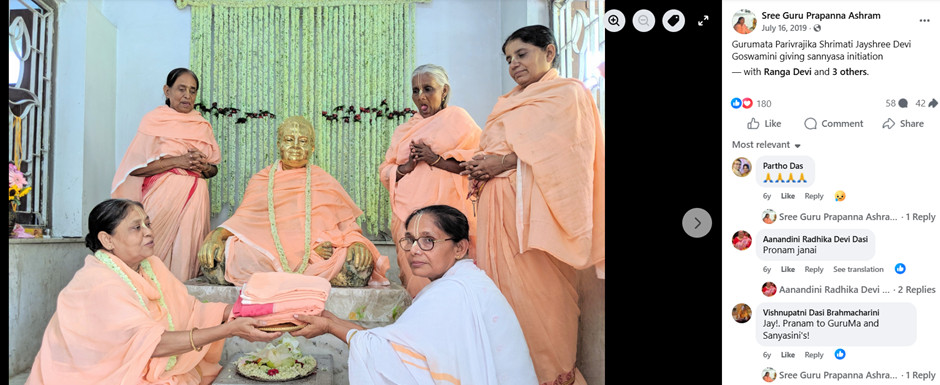
Figure 1 “Gurumata Parivrajika Shrimati Jayshree Devi Goswamini Giving Sannyasa Initiation.” Photograph. Posted by Sree Guru Prapanna Ashram. Facebook, July 16, 2019.
https://www.facebook.com/photo/?fbid=519220395286057&set=t.100015943028917.
Accessed December 28
End Notes
[1] Sastric Advisory Council (ISKCON). Brahma-gayatri: A Comprehensive Paper by the Sastric Advisory Council. Mayapur: ISKCON GBC, September 2023. https://gbc.iskcon.org/wp-content/uploads/2023/09/Brahma-gayatri-SAC-complete.pdf.
[2] Tripurari, Swami. “Women and Sannyasa.” Swami Tripurari (blog), December 16, 2002. https://swamitripurari.com/2002/12/women-and-sannyasa/.
[3] Tripurari, Swami. “Inspiration, Self-Deception, and More on Women and Sannyasa.” Swami Tripurari (blog), January 30, 2003. https://swamitripurari.com/2003/01/inspiration-self-deception-and-more-on-women-and-sannyasa/.
When is iskon established Srila swami prabhupad that day is Failed the Sampradaya..no need to permission with out Madva Goudia vaishava sampraday acharya Parampara?
What krishna says ‘ Evam Parparapratamim Rajarsiye vidhuhu..
Sakaleneha Yogo nasta paratapa’
It’s mean any Krsna consciousness Organisation need to adapat Goudia Acharya who is now days acharya..any organization must Go and Request pls Teach Us.. that is the evam parampa..
Hare Krishna
Jai Srila Guru dev.
Jai Srila prabhu pad.
Sri Guru Gourangau Vijayetham..